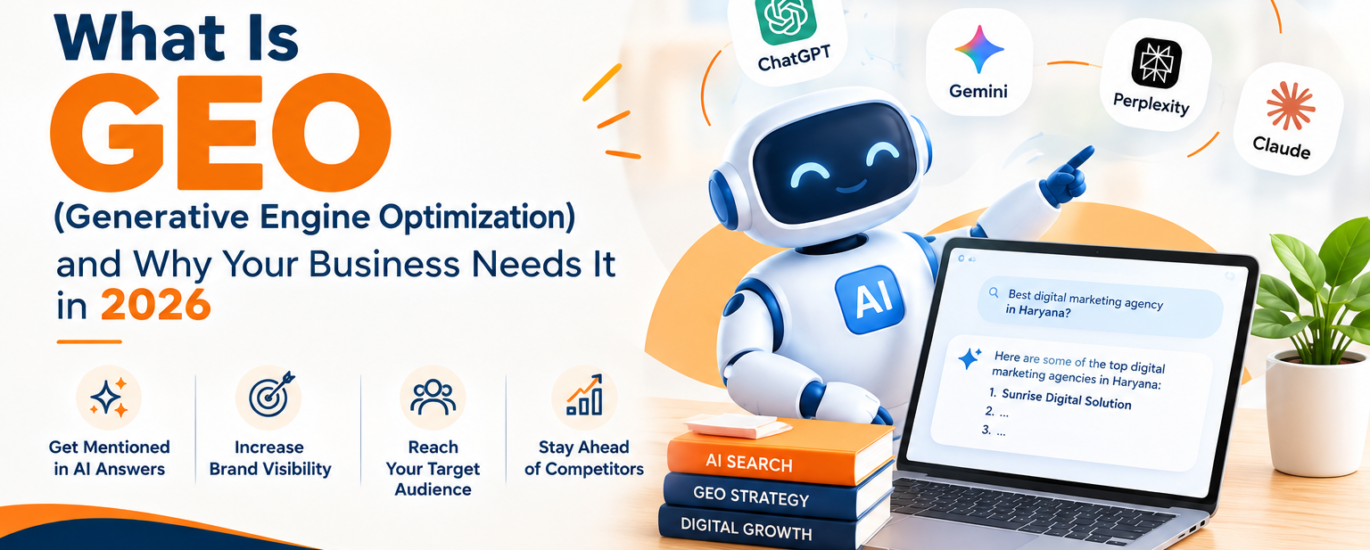
A few years ago, “getting found online” meant one thing: ranking on Google. In 2026, that’s no longer the full picture. A growing number of people now ask ChatGPT, Google’s AI Overviews, or Perplexity a question directly — and get an answer without ever clicking through to a website.
This shift has created a new area of digital marketing called GEO — Generative Engine Optimization. If your business has never heard the term, you’re not behind yet. But you will be soon if you ignore it.
GEO is the practice of optimizing your content so that AI systems — chatbots, AI-powered search summaries, and generative tools — are more likely to mention, cite, or recommend your business when answering a user’s question.
Unlike traditional SEO, which focuses on ranking your webpage on a results list, GEO focuses on becoming part of the answer itself. Instead of a user clicking your link, an AI tool might simply say: “For SEO services in Haryana, businesses like Sunrise Digital Solution offer…” — without the user ever visiting a search results page at all.
This isn’t a replacement for SEO. It’s an additional layer built on top of it, because the same fundamentals — clear content, real expertise, genuine credibility — matter to both.
Search behavior is genuinely changing, not just shifting slightly. Most searches today are increasingly answered directly by AI before a user ever visits a website, and while this means less raw traffic reaches individual sites, research shows AI-driven discovery tends to bring higher-intent visitors — people who did their research inside an AI tool and then came directly to a brand, ready to act.
In practice, that means: even if GEO doesn’t show up clearly in your Google Analytics traffic numbers, it can still be quietly influencing who chooses your business — because the AI tool already vetted you before the customer ever searched your name directly.
| Traditional SEO | GEO |
|---|---|
| Optimizes for ranking position on a results page | Optimizes for being mentioned/cited in an AI-generated answer |
| Success measured by clicks and traffic | Success measured by mentions, citations, and brand recall |
| Keyword-focused | Context and credibility-focused |
| One page competes for one ranking spot | Content clusters build topical authority across many related questions |
Both still rely on the same foundation: genuinely useful, well-structured, trustworthy content. GEO doesn’t replace good SEO practice — it raises the bar on how clearly and credibly that content needs to be presented.
1. Answer questions directly and clearly AI systems favor content that gets to the point. If a page buries the answer under vague marketing language, it’s harder for an AI tool to extract and trust it.
2. Build real credibility signals Who wrote the content, why they’re qualified, and what proof backs up the claims all matter more now. Genuine testimonials, case studies, and author information help — generic, unverifiable claims don’t.
3. Organize content into topic clusters Instead of one isolated blog post, connected content — a core page supported by related articles that link to each other — tends to build stronger topical authority for both traditional search and AI systems.
4. Get mentioned elsewhere, not just linked Unlinked brand mentions across the web are increasingly treated as trust signals, almost like an “implied” recommendation. Being talked about — in reviews, forums, guest content, local news — matters even without a direct backlink.
5. Keep human oversight on AI-generated content AI-written content is now common across the web, but the sites performing best are the ones where a real person reviews, edits, and adds genuine expertise before publishing — not raw, unedited AI output.
If your website and Google Business Profile are still incomplete or outdated, GEO isn’t your priority yet — the fundamentals still come first. But if you already have solid Local SEO and on-page basics in place, this is the next real opportunity: most small and mid-sized businesses haven’t started thinking about GEO at all, which means the businesses that move early have a genuine head start.
You don’t need to overhaul your entire content strategy overnight. Start small:
If you’d like a straightforward read on how your current content stacks up for this shift, we’re happy to take a look and point you toward the highest-impact fixes first.
FAQs
Q: Is GEO the same as SEO?
No. SEO optimizes your website to rank on a search results page. GEO optimizes your content so AI tools like ChatGPT or Google’s AI Overviews mention or recommend your business directly in their answers. They work together, not as replacements for each other.
Q: Do I need to stop doing SEO and switch to GEO?
No — GEO builds on top of solid SEO fundamentals. If your website and Google Business Profile aren’t in good shape yet, fix those first. GEO is the next layer once the basics are working.
Q: How do I know if my business is showing up in AI search results?
Try asking ChatGPT, Perplexity, or Google’s AI Overview a question a customer might ask (e.g. “best SEO agency in Haryana”). If your business isn’t mentioned, that’s a sign to start improving your content’s clarity and credibility signals.
Q: Is GEO only relevant for big brands?
No. Because most small businesses haven’t started optimizing for GEO yet, smaller and local businesses actually have a real opportunity to get ahead early — the field isn’t crowded yet.